

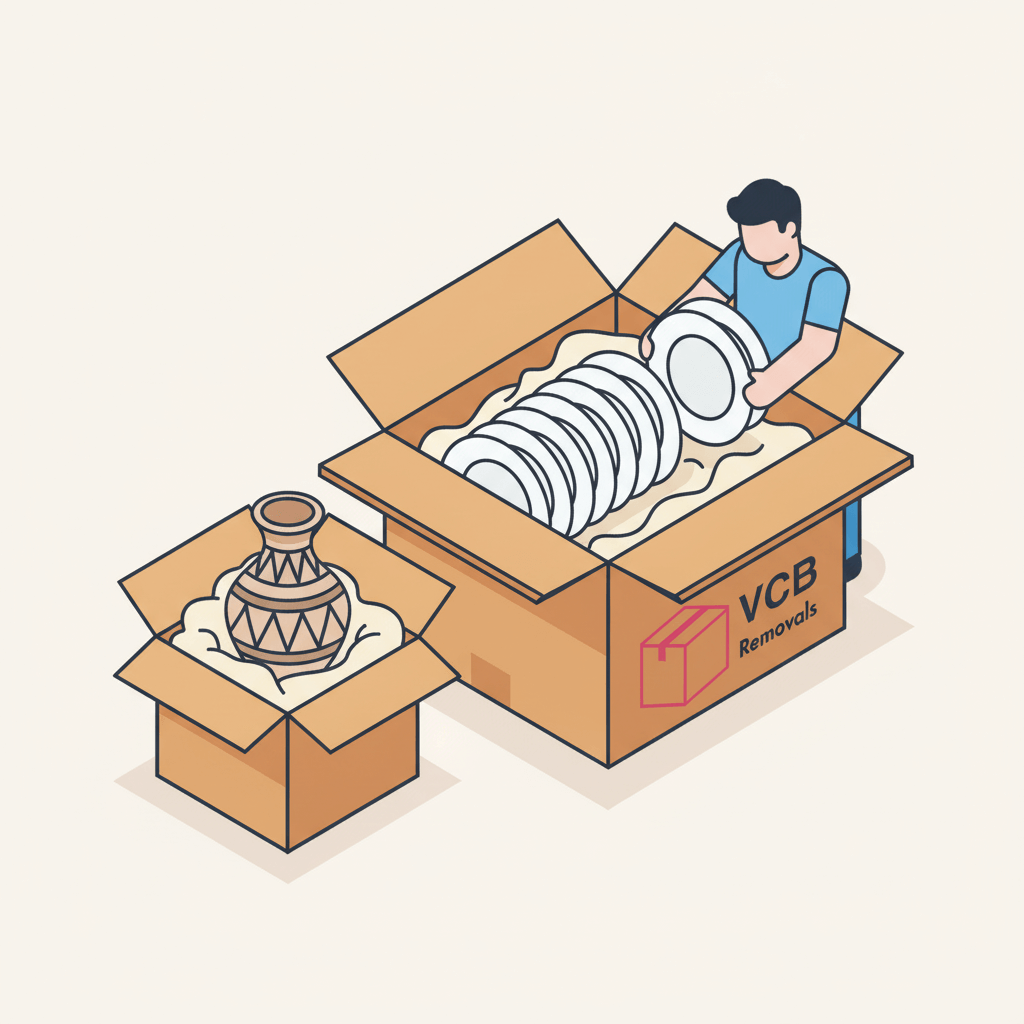
Moving house is rarely just about moving boxes. It is about moving lives. And within those lives, there are certain items that hold more than just monetary value. That grandmother’s vase, the antique mirror that has reflected three generations of faces, or the delicate glassware collection you have slowly built over years of travel—these aren't just objects. They are memories solidified in fragile forms.
The anxiety of hearing a crunch or a shatter inside a moving box is real. It is one of the biggest stressors we see when clients approach us. But here is the truth: breakage is not an inevitability of moving. It is almost always a failure of preparation.
At VCB Removals, we believe that if an item is worth keeping, it is worth protecting. We have moved thousands of homes across Bedfordshire, Buckinghamshire, and Hertfordshire, and we have handled everything from fine art to fragile porcelain. This experience has taught us that safety comes down to physics, materials, and patience.
Here is how we approach the most delicate tasks, so you can apply the same rigour to your own packing.
The Foundation of Safety: Materials Matter
You cannot protect a £500 antique with a free cardboard box you found behind a supermarket. The structural integrity of your packing materials is the first line of defence.
For fragile items, standard boxes often lack the necessary rigidity. We always use double-walled corrugated boxes for heavy, breakable items. The extra layer of corrugated cardboard provides a shock-absorbing buffer that single-walled boxes simply cannot offer. When a box is stacked in a van, it needs to resist compression. If the box bows, the pressure transfers directly to your delicate china.
Beyond the box, you need the right internal armour:
- Packing Paper: Not newspaper. Newsprint ink can stain porous surfaces like china or unvarnished wood. We use acid-free, clean white packing paper.
- Bubble Wrap: This is for impact protection, not just filling space.
- Biodegradable Loose Fill: For filling voids and preventing internal movement. As an environmentally conscious company, we prefer sustainable options over Styrofoam peanuts whenever possible.
The Theory of No Movement
The single biggest enemy of fragile items during transit is vibration and movement. If an item can shift inside the box, it can break. If two items can touch, they can chip.
Our golden rule is simple: Nothing touches nothing.
When we pack a box of crystal glasses, for example, each glass is individually wrapped. But we don't stop there. The bottom of the box gets a thick "cushion" layer of crumpled paper or bubble wrap. This acts as a suspension system, absorbing the bumps of the road.
Once the items are placed inside, we fill every single gap. We mean every gap. Corners, spaces between stems, and the top void before the flaps are closed. When you shake a packed box (gently!), it should feel like a solid brick. If you hear a rattle, you need more padding. It is better to use slightly more packing material than to risk a break.
Tackling the Tricky Items: Glassware
Stemware is notoriously difficult because the stems are snapped easily by lateral pressure. Many people make the mistake of wrapping the glass and throwing it in.
The correct technique involves supporting the weakest point. We wrap the stem first, often creating a "collar" of paper or bubble wrap that makes the stem as thick as the bowl of the glass. This turns the irregular shape into a cylinder, which is much stronger and easier to pack vertically.
Always pack plates and glasses vertically, never flat. Plates stacked flat on top of each other will crack under their own weight when the van goes over a speed bump. Standing them on their edges (like vinyl records) allows the box structure and the padding to take the weight, not the delicate ceramic centres.
Antiques and Odd Shapes
Antiques rarely come in uniform shapes. A Victorian chair or a gilded mirror requires a bespoke approach. This is where "export wrapping" comes into play—a technique we use frequently for our international and high-value moves.
For furniture with delicate legs or ornate carving, we don't just throw a blanket over it. We use bubble blankets—a laminate of bubble wrap and soft paper—cut to size and secured tightly.
For large mirrors or artwork, we use a method called "cardboard telescoping" or custom crating. We build a protective shell around the item using heavy-duty card, ensuring the corners—the most vulnerable points—are reinforced with extra protection.
If you are handling this yourself, tape an 'X' across the glass of large frames or mirrors using masking tape. If the worst happens and the glass breaks, the tape holds the shards together, protecting the artwork or backing behind it from getting slashed by loose glass.
Disassembly is Protection
Sometimes, the best way to move a fragile piece of furniture is to take it apart. A heavy mahogany table with slender legs is a leverage disaster waiting to happen. The torque created by moving the table can snap a leg cleanly off.
Part of our standard process involves carefully disassembling these large pieces. We remove legs, glass tops, and shelves. Each piece is labeled and wrapped separately. We tape the screws and fixings in a bag directly to the underside of the main piece so nothing gets lost.
If you are unsure whether a piece should be disassembled, err on the side of caution. If it can be taken apart, it probably should be.
Labelling: The Silent Communicator
You can pack a box perfectly, but if the person carrying it doesn't know what's inside, it is still at risk.
"Fragile" tape is useful, but it can become background noise. We are specific. We write "Top Heavy," "Glass – Do Not Stack," or "Art – Keep Upright."
We also advise creating a "Open First" box for your essentials, but also a "Do Not Move" zone in your house before we arrive. If you have extremely high-value jewellery or small, sentimental heirlooms, keep them with you personally. For everything else, clear labelling ensures our team knows exactly how to handle the load.
When to Call the Professionals
There is a distinct difference between packing books and packing a chandelier. While many of our clients are happy to pack their clothes and kitchen utensils, they often ask us to handle the "breakables."
We offer a range of services from full property clearances to specific packing assistance. If you have a room full of antiques or a cabinet of crystal, it might be more cost-effective to have us pack just those items than to risk replacing them. Our team arrives equipped with the high-quality materials and the technical know-how to ensure safe transit.
We founded VCB Removals because we saw a lack of genuine care in the industry. We treat your possessions with the same respect we would want for our own families. Whether you are moving down the road in Bedfordshire or relocating across the country, we are here to make the process seamless.
If you are looking for a team that prioritises the safety of your belongings above all else, we are ready to help. You can learn more about our packing services and get a competitive quote by visiting VCB Removals. Let us handle the heavy lifting and the delicate touches, so you can focus on settling into your new home.